
Overcoming the “Silent Sister” of Endometriosis in Dubai
Looking for adenomyosis treatment in dubai? Many women spend years enduring debilitating menstrual cramps, severe lower back aching, and heavy, clotting periods under the assumption that intense pain is simply an unavoidable part of menstruation. When standard painkillers fail to provide relief, the underlying cause is frequently Uterine Adenomyosis.
Often referred to as the “silent sister” of endometriosis, adenomyosis occurs when the tissue that normally lines the inside of the uterus (the endometrium) breaks through the protective boundary and grows directly into the muscular uterine wall (the myometrium). During every menstrual cycle, this misplaced tissue thickens, breaks down, and bleeds inside the uterine muscle, resulting in chronic inflammation, painful uterine enlargement (a “globular” or “boggy” uterus), and heavy bleeding.
Consulting an experienced specialist like Dr. Sunita Arora in Dubai ensures that adenomyosis is accurately diagnosed using high-resolution 3D transvaginal ultrasound and managed through individualized hormonal, uterine-sparing, or minimally invasive surgical treatments.
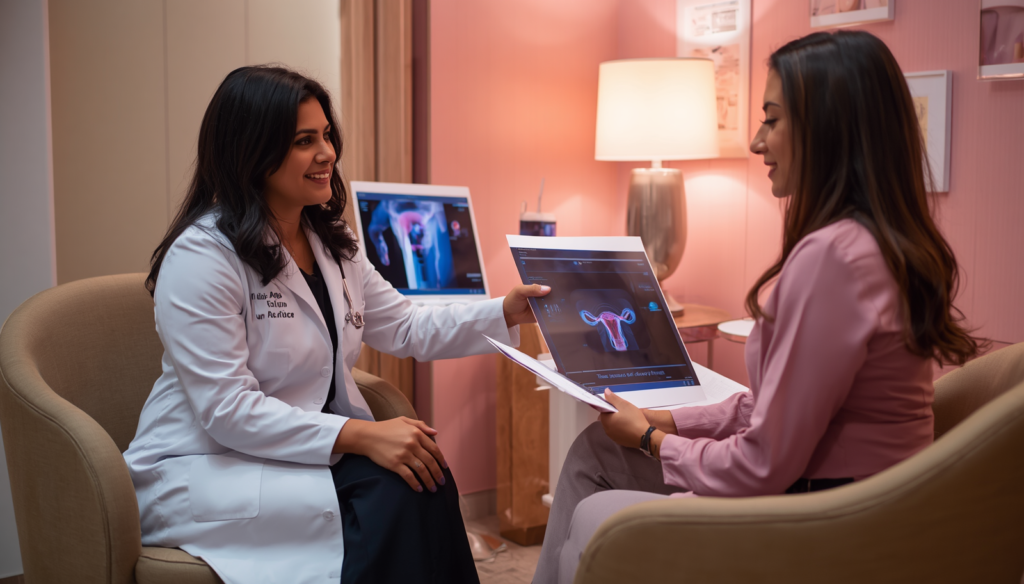
Clinical Deep Dive: Junctional Zone Dysregulation, Hyperperistalsis & Myometrial Hypertrophy
Understanding adenomyosis requires examining how endometrial-myometrial disruption alters uterine function.
Key Pathophysiological Pillars of Adenomyosis
- Disruption of the Junctional Zone (JZ): The inner boundary where the endometrium meets the myometrium becomes thickened (measuring $>12\text{ mm}$ on high-definition ultrasound or MRI). Mechanical micro-trauma from prior C-sections, uterine curettage, or intrinsic hyperperistaltic contractions allows endometrial cells to invade the myometrium.
- Intramyometrial Micro-Bleeding & Fibrosis: Trapped endometrial glands continue to respond to cyclic estrogen and progesterone. Cyclic bleeding within the muscular wall cannot exit through the cervix, triggering focal inflammation, tissue swelling, and reactive smooth muscle hypertrophy.
- Uterine Vascularity & Heavy Bleeding (Menorrhagia): The enlarged, boggy uterus loses its ability to contract its spiral muscular fibers efficiently around uterine blood vessels during menstruation, leading to prolonged bleeding, large blood clots, and secondary iron-deficiency anemia.
- Dyspareunia & Chronic Pelvic Heaviness: Uterine enlargement and local nerve sensitization cause deep pelvic aching, painful intercourse, and pressure against the bladder and bowel.
“Adenomyosis is frequently underdiagnosed because its symptoms overlap with fibroids and endometriosis. With high-definition 3D transvaginal ultrasound, we can pinpoint junctional zone thickening and micro-cysts early, offering targeted medical and uterine-preserving therapies that stop heavy bleeding and eliminate chronic pain.”
American Board of Cosmetic Gynecology (ABCG)
Clinical Workflow for Adenomyosis Diagnosis & Management
The step-by-step clinical workflow for a adenomyosis treatment in dubai is:
1. Comprehensive Symptom Profiling & Bleeding Assessment
Detailed tracking of menstrual cycle duration, clot size, pelvic pain severity (using standardized visual analog scales), dyspareunia, and screening for iron-deficiency anemia.
2. High-Definition 3D Transvaginal Ultrasound & Doppler Mapping
Evaluating uterine symmetry, measuring junctional zone thickness, identifying myometrial micro-cysts, linear sub-endometrial striations, and the characteristic “rain-shower” acoustic shadowing.
3. Targeted Non-Hormonal & Anti-Inflammatory Relief
Prescribing tranexamic acid to reduce menstrual blood flow volume alongside targeted non-steroidal anti-inflammatory agents (NSAIDs) to inhibit local prostaglandin production.
4. Hormonal Suppression & Localized Progestin Therapy
Placing a Levonorgestrel-releasing Intrauterine System (LNG-IUS / Mirena) or prescribing oral dienogest / continuous progestins to atrophy misplaced endometrial tissue within the myometrial wall.
5. Minimally Invasive Uterine-Sparing or Definitive Surgery
For patients unresponsive to medical therapy, offering laparoscopic focal adenomyomectomy (preserving the uterus for fertility) or total laparoscopic hysterectomy as a definitive cure.

Frequently Asked Questions
Adenomyosis can affect fertility by altering uterine peristalsis, causing chronic myometrial inflammation, and impairing embryo implantation. However, targeted hormonal down-regulation (such as pre-treatment with GnRH agonists) or conservative surgical debulking helps many women achieve successful, healthy pregnancies. Visit for adenomyosis treatment in dubai.
No. Adenomyosis is a completely benign (non-cancerous) gynecological condition. While its symptoms of pelvic pain and heavy bleeding can be severe, it does not transform into uterine cancer. Visit for adenomyosis treatment in dubai.
Also Read: Recurrent Vaginal Infections & Dysbiosis in Dubai: Long-Term Treatment for Chronic BV and Thrush
Compassionate Women’s Healthcare & Pelvic Pain Care in Dubai with Dr. Sunita Arora
Living with constant pelvic heaviness, heavy menstrual bleeding, and exhaustion from chronic anemia is not something you have to accept. With modern high-resolution 3D ultrasound diagnostics, localized hormonal therapies, and fertility-preserving surgical options, long-term symptom relief is achievable.
With over 24 years of international clinical experience, Dr. Sunita Arora delivers dedicated, patient-centered gynecological care across Dubai. Accredited by the Royal College of Obstetricians and Gynaecologists (MRCOG, UK), the Royal College of Physicians of Ireland (MRCPI), and holding a Fellowship in Cosmetic & Functional Gynecology (ABCG), Dr. Arora offers comprehensive adenomyosis evaluations and personalized pelvic pain management at JTS Medical Centre and Dubai London Hospital.


